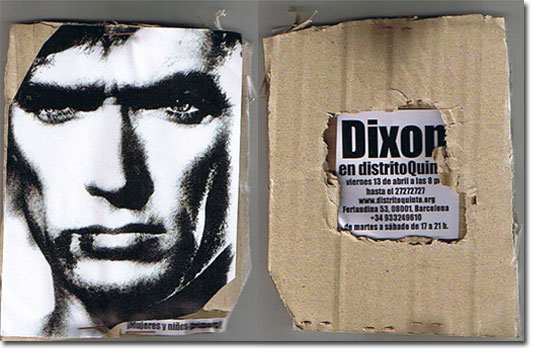
Estos dias estoy trabajando en una instalación de video para Dixon. Este artista de street art va a exponer en la galeria distritoQuinto (mapa). Su exposición se llama “mujeres y niños primero!” y la inauguración será el 27 de abril 2007.
***
Right now I am working on a video installation for Dixon. This Street Artist inaugurates his exposition “Women and children first!” on April 27th 2007 at the distritoQuinto gallery (map).
filed under: barcelona
installation
me
streetart
video

I want to share an interesting interview with Tim O’Reilly, in which he tells the editors of wired magazin what he thinks of the actual buzz about Web 2.0. His main argument is that it has little to do with ajax and visual styles, but rather about “Controlling Data” on the web.
Just to remember: Tim O’Reilly invented the term “Web 2.0” in the article “What is Web 2.0? – Design Patterns and Business Models for the Next Generation of Software”, trying to aggregate several structural developments that were/are occuring on the web.
filed under: article
interview
web

I am happy to announce that Nati has finished her new project “Love & Culture“. It is a website dedicated to present cientific articles about long distance and bicultural relationships. Check it out and give her some feedback!
filed under: webdesign

Copyright is one of the big controversial topics that have emerged in times of digitality and Internet. Yesterday, I attended the now festival at Centre de Cultura Contemporània de Barcelona (CCCB) where Jost Smiers discussed his suggestions concerning copyright and artistic/cultural production.
Smiers is a professor for political sciences and investigator for the arts and economics research group at Utrecht School of Arts in the Netherlands.
He stated that the whole problem of copyright is closely connected to the presence of big media conglomerates that use it as investment protections for their businesses. The legitimate economic recompensation for artists is therefore kidnapped by those interests. The solution he offers, a three step plan, is as easy as utopic to achieve:
- Put “enormous amounts of money” into research programs that investigate the relationship between the cultural sphere and those conglomerates (like Bertelsmann, Rupert Murdoch’s News Corporation, etc)
- Create a free cultural market by reviewing the competition laws and destroying those illicit companies.
- Abolish copyright.
When this is achieved, Smiers explained, a market system that bases on reputation rather than exclusion would emerge. Everyone would be able to share and remix everything and via government subsidies certain arts that require bigger investments should be financed.
What I personally found very interesting is, that Smiers had a quite critical attitude towards the copyleft movement. “Sharing is nice, but as an artists you also have to make a living”, he argues and calls the the creative commons “a coalition of the willing” where only those participate that have a stable income or do not depend on the economic value of their cultural artifacts. The real problem, he criticizes, the economic aspects of the cultural sphere – is not addressed.
Este miércoles (21.3.07), como siempre en el bar Los Alamos,
habrá proyecciones de diferentes cortometrajes – incluyendo el video-danza 60” que hice con Sandra Trejos en Suiza el año pasado.
La entrada es gratis y la dirección del bar es la siguiente:
Bar Los Alamos, Calle Escudellers 12 – Barcelona (Barrio Gotico, metro Drassanes)
Además, este es el programa completo para el 21. de marzo 2007:
SUBJUNTIVO de Alejo Ubach y Bruno Zaffora (Buenos Aires 2005)
Un hombre que perdió la memoria se ve forzado a realizar una investigación y descubrir quienes son las personas que aparecen en una foto segundos antes de morir. Pero no sabe que descubrir la identidad de esos extraños es aun más peligroso que rehusarse a hacerlo.
60” de Fritz Gnad (Suiza 2006)
La ciudad suiza de Bienne podría ser denominada como el epicentro de la puntualidad suiza, ya que en ella se encuentran las manufacturas de los relojes Swatch, Rolex, y Omega; pero además, también se puede percibir fuertemente el pasar de los segundos en la vida cotidiana de sus habitantes y de la ciudad en general. La coreógrafa costarricense Sandra Trejos y el videoartista alemán Fritz Gnad, en su videodanza “60 Segundos”, se acercan tanto al tema del tiempo como al de su percepción.
HEAVEN de Santiago Riscos, Angela Mogollón y Rafael Cano (Barcelona)
Andrés quiere suicidarse, pero no sabe lo que le espera detrás de la muerte… ¿Seguirá conectado de alguna manera al mundo de los vivos?
ANTIVIRUS de Santiago Riscos, Rafael Cano, Khris Cembellín y Santi Justribó (Barcelona)
El sistema es un asco, pero al menos los amaneceres son bonitos… Todos los archivos duermen en sus carpetas, pero el Agente especial McAfee de la patrulla antivirus vela por la seguridad del sistema y defiende a los archivos de los correos sospechosos.
SPLIT de Luis Yrache Jimenez, Marcello Vai y Andrea Maccaroni (Barcelona 2004)
SHAKY WHITE GUYS MAKING FRIENDS de Erik Eliason (Suecia 2007)
Otra forma de amistad entre hombres. Un viaje audio-visual con elementos mezclados entre video y animación.
CUNT WISH BLUES de Erik Eliason (Suecia 2006)
Sueños de un chico que vive en una isla.
SPLENDID EYE EXPLOSION de Marco Silvestri (Barcelona 2006)
filed under: barcelona
me
screening
video
El Raval representa, en esta obra, una expresión local de la globalización. Este barrio, que es al mismo tiempo un nicho de culturas en constante interactividad y fuente de creación artística, nos muestra imágenes de un street art marcado por las diferencias sociales, culturales y el ritmo urbano de una ciudad en cambio constante.
Todas estas características del Raval han sido posible obtenerlas sin necesidad de encontrarnos precisamente en ese sitio. Internet nos ha facilitado obtener imágenes del Raval, que nos permiten conocerlo desde los ojos subjetivos de sus habitantes o visitantes. El proceso creativo de esta obra ha sido meramente descentralizado, gracias a las licencias de Creative Common, las cuales permiten el uso libre de materiales visuales y de audio. ravalejar se convierte, así mismo, en materia prima para futuras creaciones.
***
The Raval represents in this work the local expression of globalization. It is a cultural niche of constant activity and, at the same time a source of artistic creativity. These images show a street art marked by social and cultural differences, and an urban rhythm of a city in constant change.
Creative Common Photos taken from flickr.com and the music of 12rec.net artist rob steady were used to achief a decentralized creative workflow.
filed under: barcelona
me
streetart
video

Post-structuralism has lost one of his most influential thinkers: Jean Baudrillard, mind-father of simulacra and simulation died this Tuesday, March 6th.
With his comments on the 1991 Gulf War he gained broad public attention as a political commtator: He claimed the war to be a ‘virtual war’, that ‘did not take place’ due to the mediatic representation and its lack of consequences.
filed under: media sciences
philosophy
“Es como decir que a la ciudad la pintan de blanco y cada uno se encarga de ensuciarla…”
La ciudad blanca refleja el sucio paisaje de aquellas ciudades y pueblos latinoamericanos que debido a las intervenciones externas, impregnadas de políticas neoliberales, van decayendo y cambiando las estructuras de los espacios públicos y privados, tanto de las instituciones como de sus mismos ciudadanos. Es un loop de oscuridad, suciedad e impotencia sobre este monstruo en que se ha convertido aquella ciudad.
Hoy en día la resistencia es evidente, pero así tambien la contínua presencia de las potencias sobre estos territorios.
filed under: costa rica
me
video